Dhoya Tulsi Pata to Dhuss Bhallage Na: The Bangla Phrases Behind Our T-Shirts
Every Bengali household has a few lines that get used so often nobody thinks about them anymore. Your mashi says one when you claim you didn't eat the last rosogolla. Your friend says another when the plan for Sunday is cancelled again. They are tiny, funny, slightly dramatic, and they say more than a full paragraph in English ever could.
Most of the designs in our Bengali quotes t-shirts started exactly like that: someone in the studio said a line out loud, everyone laughed, and it went on the sketchbook. Here are the stories and meanings behind some of them, for the Bengalis who grew up hearing them and for anyone who has a Bengali friend and keeps wondering what on earth they are saying.
1. Dhoya Tulsi Pata (ধোয়া তুলসী পাতা)
Literal meaning: a washed tulsi leaf.
What it really means: someone who pretends to be completely innocent.
Tulsi is sacred in a Bengali home, and a freshly washed tulsi leaf is about as pure as anything can be. So when someone says "o to ekebare dhoya tulsi pata", they don't mean it kindly. It is said about the cousin who broke the vase and is now sitting very quietly with a book, or the colleague who swears they had nothing to do with the office gossip. Our tee flips it around: the line on the front proudly says you are not a washed tulsi leaf.

Find it in navy and green, and as a full sleeve for winter.
2. Amar Sada Mone Kada Nei (আমার সাদা মনে কাদা নেই)
Literal meaning: there is no mud in my white (clean) heart.
What it really means: "I meant no harm, honestly."
This is the line you use right after saying something a little too blunt. You told your friend their new haircut looks like a broom, they look hurt, and you quickly add, "arey, amar sada mone kada nei". It is half apology, half defence, and fully Bengali. People who wear this one are usually the ones who speak their mind first and explain later.
Available in black, mahogany maroon and bottle green.
3. Ghatabe Na (ঘাটাবেন না)
Literal meaning: don't stir (me) up.
What it really means: leave me alone, I am not in the mood.
Ghatano means to poke or stir something that should be left as it is. Amake ghatabe na is the polite-sounding warning before someone loses their temper. It is what your baba says when you bring up the electricity bill during the cricket match. We drew it with a raised fist because, let's be honest, that is the energy.

Wear it in yellow, sky blue or white melange.
4. Dhuss, Bhallage Na (ধুস, ভাল্লাগে না)
Literal meaning: ugh, I don't like it.
What it really means: general boredom with life, Mondays, and everything in between.
If Bengalis had a national sigh, this would be it. Dhuss on its own can mean disappointment, irritation or simple tiredness, depending on how long you stretch the "uu". Add bhallage na and you have the perfect reply to "what's wrong?" when nothing in particular is wrong. Our design has a sleepy sloth under the words, which felt right.
5. Tumi Boro Seyana, Bhabo Loke Bojhe Na
Meaning: "You think you're very clever and nobody notices."
Every para has one person who always has a plan, a shortcut, a trick for getting the front seat. This is the line everyone else says about them, usually with a raised eyebrow. It is a gentle roast, not an insult, and it works best on a friend who will laugh along. The maroon tee is one of our most gifted designs for exactly that reason.
6. Bhadro Hoye Ar Kaj Nei
Meaning: "Enough of being polite."
You stood in the queue. You let the uncle with three bags go ahead. You smiled when the shopkeeper served someone else first. And then, finally: bhadro hoye ar kaj nei. It is the moment of quiet rebellion that comes after too much patience. We set it in thick, blocky Bangla on a bright red tee, because quiet it is not.
7. Ebar Sonnyas Nebo
Meaning: "That's it, I'm becoming a monk."
Nobody actually leaves for the Himalayas, of course. This is the line after a terrible week at work, a breakup, or a third failed attempt at making luchi that puffs up. It is dramatic, exaggerated and completely relatable. Find it in bottle green or black.
8. Amar Je Ki Hobe?
Meaning: "What will become of me?"
Asked before every exam result, every appraisal and every wedding season when relatives start asking questions. The beauty of the phrase is the extra je in the middle, which turns a simple question into full-blown theatre. Our navy tee gives it the dramatic question mark it deserves.
9. Seta Kono Boro Kotha Noy
Meaning: "That's no big deal."
The opposite of amar je ki hobe. This is the friend who missed the train, lost their phone and still says seta kono boro kotha noy while ordering another cup of cha. A good line to keep in your pocket for bad days. It comes with a cheeky cartoon monkey on our navy design.
10. Dekhle Hobe? Khorcha Ache!
Meaning: "Just looking? That costs extra!"
A line straight out of the old Kolkata shopkeeper's handbook, now used whenever someone expects something for free. Ask for a lift, a favour or the last piece of fish, and you might hear it. We added a rising graph to the black tee for a little finance-bro humour.
11. Olpo Salary, Shopno Rokomari
Meaning: "Small salary, all kinds of dreams."
The anthem of every young Bengali in their first job. The trip to Bali is planned, the new phone is in the cart, and the salary arrives on the first and disappears by the fifth. If that sounds familiar, the Olpo Salary tee is for you.
12. Dada, Ekta Chakri Hobe?
Meaning: "Brother, is there a job going?"
Said to every senior, every neighbour's son-in-law and every uncle with a contact. It is funny because it is true. Our bottle green design is a hit with final-year students and job seekers who can still laugh about it.
A few single words that need no sentence
Some Bangla words carry a whole personality on their own:
- Lyadh (ল্যাদ): that heavy, happy laziness after a big Sunday lunch. Our Lyadh Khor tee is for the professionals.
- Petuk (পেটুক): a glutton, said with love. See the Petuk Maharaj, who is clearly enjoying his plate of rice.
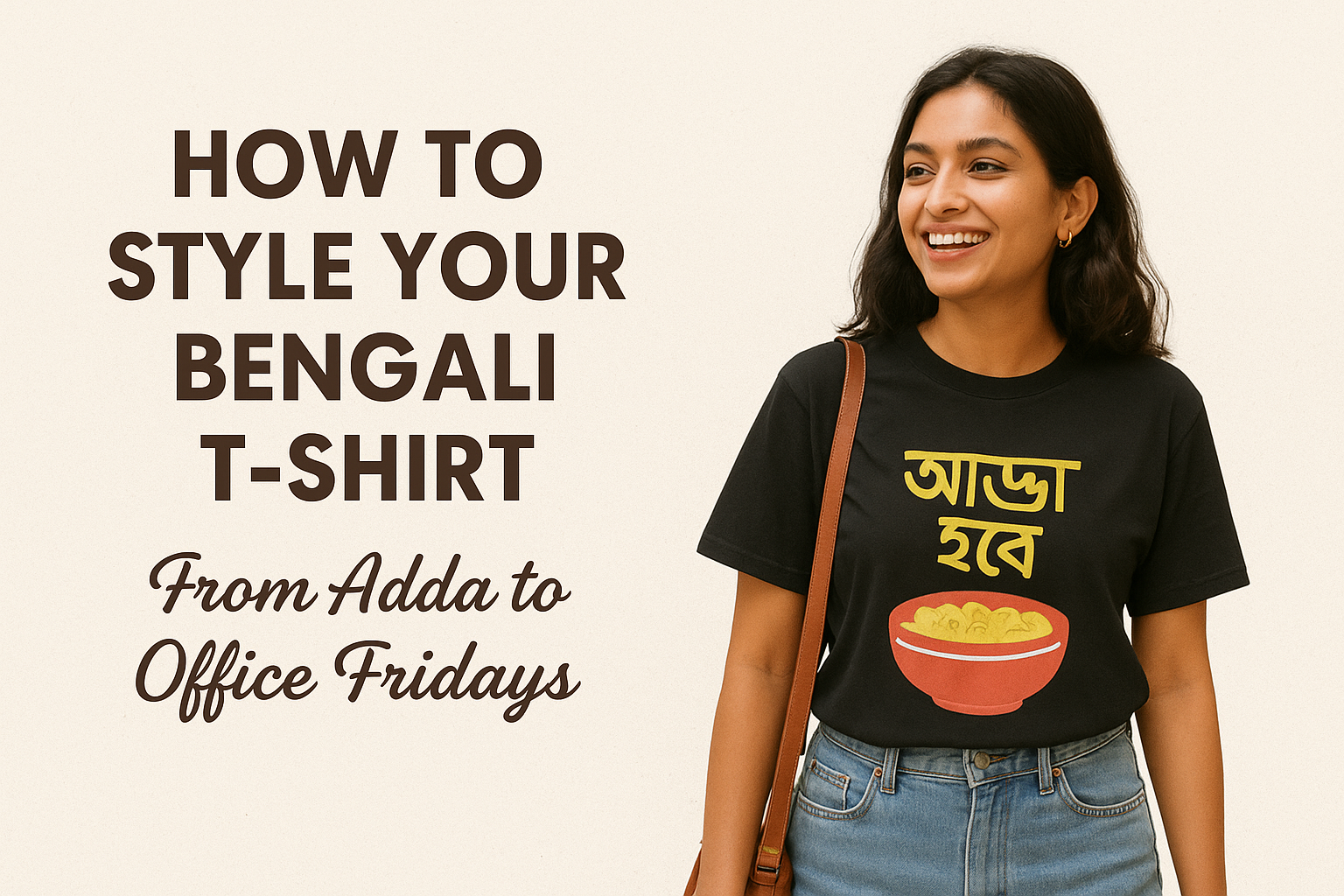
- Addabaj (আড্ডাবাজ): someone who could do adda for six hours and still say "ar ektu". The Addabaj tee is made for them.
- Baundule (বাউন্ডুলে): a carefree drifter with no fixed plans. Our Baundule design sends the letters flying like kites.
- Bhaboghure (ভবঘুরে): a wanderer, a free spirit. Wear it on the navy Vabaghure tee.
- Bhromon Bilashi (ভ্রমণ বিলাসী): someone who lives to travel, the friend who plans the Pujo trip in March. Here is the Bhromon Bilashi tee.
Lines about where we come from
Not every design is a joke. Some lines are about belonging:
- Cholo Jai Pahare: "let's go to the hills", the four words that start every Darjeeling plan. See the tee.
- Lal Matir Desh: the land of red soil, the laterite country of Bankura and Birbhum. Our design carries the terracotta Bankura horse.
- Dori Dhore Maro Taan: "hold the rope and pull", a call to pull together. See the tee.
- Mone Prane Bangali: Bengali in heart and soul, wherever you live now. See the tee.
- Swarabarna: অ আ ই ঈ, the Bangla vowels every child learns first. Our minimal black tee runs them down the back.
Why we put these on t-shirts
Because the best Bengali phrases are meant to be said out loud, and a t-shirt is the closest thing to saying it without opening your mouth. When someone at a pandal or a college canteen reads your tee and laughs, you have started an adda without trying. That's the whole idea.
If your favourite line isn't here yet, tell us on Instagram or WhatsApp. A lot of our designs began as a customer's suggestion. Meanwhile, browse the full range of Bengali t-shirts, start with our Bengali quote t-shirts if you want something to make people smile, or see what's new for Pujo in the Durga Puja collection.
Ashche Pujo, and happy pandal hopping from all of us at COUP.
How We Design Quirky Bengali T-Shirts at The Coup
Bengali T-Shirt Size Guide: How to Choose the Right Fit (and Make It Last)
Related Posts

Bengali Kids T-Shirts as Gifts: Birthdays, Pujo, Hate Khori and More

Matching Couple Outfits for Pujo and Bengali Weddings: Ideas That Actually Work

Bengali T-Shirt Size Guide: How to Choose the Right Fit (and Make It Last)
How We Design Quirky Bengali T-Shirts at The Coup
Magoj Dholai T-Shirts | Funny Bengali Political Tees
Sukumar Ray and the Charm of Bengali Quirky T-Shirts